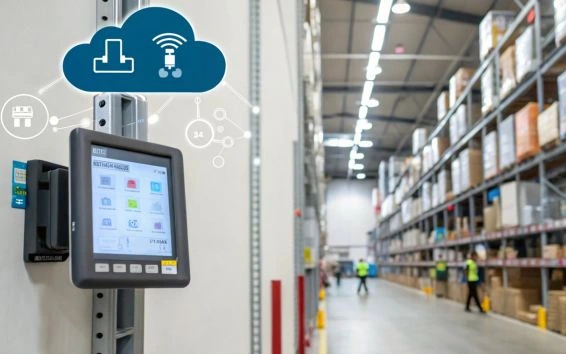


Step inside a large fulfillment center in West Java and you’ll notice something subtle. The pace feels different.
Goods move along conveyor belts instead of being pushed by hand. Inventory appears on screens instead of paper sheets. Workers scan, confirm, and move. Fewer delays. Less bottlenecks.
Warehouse automation is steadily changing how Indonesia stores and distributes goods. It is not dramatic, nor is it futuristic. Yet it is becoming normal. And that shift says something important about where the country’s industrial system is heading.
Indonesia’s economy continues to expand, driven by domestic consumption and manufacturing output. More goods are being produced. It means more products are being sold online. Additionally, much more parcels are moving every day.
According to Badan Pusat Statistik, Indonesia’s e-commerce transaction value has grown consistently over the past decade, placing it among the largest digital markets in Southeast Asia.
As a result, that growth puts pressure on warehouses.
Traditional storage models — manual sorting, handwritten logs, basic shelving — struggle under high-volume order cycles. During peak sales periods, in particular, small inefficiencies multiply fast.
In response, those risks can be reduced by warehouse automation. It speeds up sorting, improves accuracy, and shortens dispatch times.
In a competitive retail environment, those improvements matter.
The logistics industry Indonesia has long faced structural challenges. The country’s geography alone complicates distribution. Goods often move across multiple islands before reaching customers.
Over time, inefficient warehousing adds cost.
Over the past few years, operators have started upgrading systems. Not all at once, nor everywhere. But consistently.
Modern facilities now integrate:
A warehouse management system links stock levels, picking routes, and delivery schedules in one interface. Managers can see where goods are stored and how fast they are moving
This reduces overstocking, while lost items become less frequent. Labor hours are also used more efficiently.
For the logistics industry Indonesia, efficiency gains are no longer optional. Margins are tight, while customer expectations are rising.
At the same time, automation inside warehouses is not driven by retail alone.
Indonesia’s manufacturing base continues to expand across food processing, consumer goods, electronics, and downstream mineral industries. As industrial growth accelerates, storage and distribution networks must keep up.
Factories producing higher volumes require faster inventory turnover. Delays inside warehouses slow entire supply chains.
In this sense, warehouse automation is not separate from industrial policy. It supports it.
Warehouse upgrades are not happening in a vacuum.
Over the past few years, officials from Kementerian Perindustrian have repeatedly linked industrial competitiveness with digital integration. The “Making Indonesia 4.0” program often gets associated with factory robotics. But logistics sits in that same conversation.
If production increases but distribution slows, the benefit weakens. That point has come up in several public forums and industry briefings.
There has also been attention from Kementerian Perdagangan on improving domestic distribution systems. Indonesia’s geography makes price stability difficult. Goods move across islands, sometimes through several storage points. Inefficiency in warehousing adds cost at each step.
So while there is no headline policy labeled “warehouse automation strategy,” the direction is visible. Digital systems, stronger coordination, better tracking — these are repeatedly mentioned as necessary upgrades.
Warehouses are simply part of that chain.
Good warehouse supports manufacturing. It supports trade. Eventually, it also supports national competitiveness.
Not every warehouse in Indonesia looks like a high-tech fulfillment hub.
Large enterprises are leading the shift. Major e-commerce platforms, multinational logistics providers, and FMCG distributors have stronger capital capacity. They can install automated storage systems and advanced warehouse management system software.
Smaller firms move more carefully.
Upfront costs remain a concern. Many automation tools are imported. Technical support is concentrated in urban centers.
Yet change is happening even among SMEs.
Cloud-based inventory systems, digital stock tracking, and partnerships with third-party logistics providers allow smaller businesses to participate without massive capital spending.
The result of warehouse automation growth is uneven, but steady.
Walk through a modern warehouse and you’ll still see people everywhere. Automation hasn’t cleared the floor. It has just changed what people do.
Instead of lifting and sorting all day, more workers stand near screens. They monitor flow. They fix small system errors. They check digital pick lists instead of paper sheets.
Some roles disappear. Others appear.
Technicians who understand warehouse management system software are in higher demand. So are maintenance staff who can troubleshoot conveyor systems or scanning devices. The skill profile is shifting.
Not overnight. But gradually.
Indonesia’s workforce is young, which helps. The challenge is training. Technical skills don’t automatically follow hardware upgrades. Companies that invest in upskilling tend to see smoother transitions. Those that don’t often face operational hiccups.
Automation changes the job mix. It doesn’t remove the need for people.
Technology alone doesn’t modernize a warehouse. Electricity is critical. Reliable internet keeps systems running. And without proper road access, distribution slows quickly.
In Greater Jakarta and West Java, upgrades are visible. Industrial estates there offer reliable utilities and better transport links. That makes automation easier to justify.
In contrast, outside Java, progress can feel slower. Some regions still deal with uneven power supply or limited digital connectivity. For warehouse operators, that raises risk. Automated systems depend on stable inputs.
Industrial park developers know this. Many newer logistics hubs now promote “digital-ready” infrastructure as part of their pitch. Fiber lines. Stable energy. Integrated loading zones.
But infrastructure builds in layers. It doesn’t transform at once.
Warehouse automation growth, in many ways, follows the same pattern. Steady. Uneven. Moving forward, but at different speeds depending on location.
Indonesia is modernizing, but it is not doing so alone.
Across Southeast Asia, logistics capacity is being upgraded. Vietnam has invested heavily in export-driven fulfillment. Thailand continues to refine its automotive and industrial distribution networks. Malaysia promotes advanced logistics infrastructure tied to electronics manufacturing.
Investors compare these markets closely.
Indonesia has one advantage that is difficult to replicate — scale. Its domestic market absorbs large volumes of goods. That means warehouse facilities are not dependent solely on export demand.
Still, scale alone is not enough.
If efficiency lags, capital shifts elsewhere. Companies today measure turnaround time, accuracy rates, and digital integration before choosing locations.
Warehouse automation, in that context, becomes less about technology trends and more about competitiveness.
Quiet upgrades now can prevent larger disadvantages later.
The idea of automating a warehouse might seem complex. But its impact is broad.
Efficient storage reduces spoilage in food supply chains. Faster delivery will make exports more reliable. Monitoring things correctly cuts down on extra purchases and stock imbalances.
That means that companies will have smoother production cycles. For retailers, it means fewer delivery failures. This upgrade also means predictable pricing and faster service for wider customers.
Warehouse automation strengthens the invisible backbone of the economy.
Indonesia’s progress is practical rather than flashy.
There are no sudden revolutions. Instead, there are conveyor upgrades, software integrations, and gradual system replacements.
Challenges remain — energy reliability in certain regions, capital costs, and skill gaps among operators. But the direction is consistent.
As industrial growth continues and the logistics industry Indonesia expands, automation will become less of a differentiator and more of a baseline requirement.
Not because it is fashionable, but because it works. In a competitive economy, what works tends to stay.
Rising e-commerce demand, expanding manufacturing output, and tighter delivery timelines are pushing logistics operators to modernize.
It makes it easier to see what’s in stock, cuts down on mistakes, and links warehouse operations to larger supply chain systems.
Roles are shifting rather than disappearing. Demand for technical and system-based skills is increasing alongside automation.
Thailand’s green industry incentives are a big step toward bringing back the...
Electric vehicles are becoming more common on Malaysian roads. With more charging...
The fintech Asia environment is very dynamic, and Vietnam is one of...
Drive through parts of West Java or the outskirts of Surabaya and...