
Travelling across Indonesia often means spending time on the road, whether you’re exploring Jakarta, visiting Bali, or travelling between major business hubs. Along the way, you’ll notice that every vehicle follows a structured licence plate format that provides more information than many people realise.
While Indonesian number plates may seem like a random mix of letters and numbers, each section has a specific purpose. Understanding how they work can help travellers, business professionals and logistics operators better understand vehicle origins, regional movements and the country’s transport system.
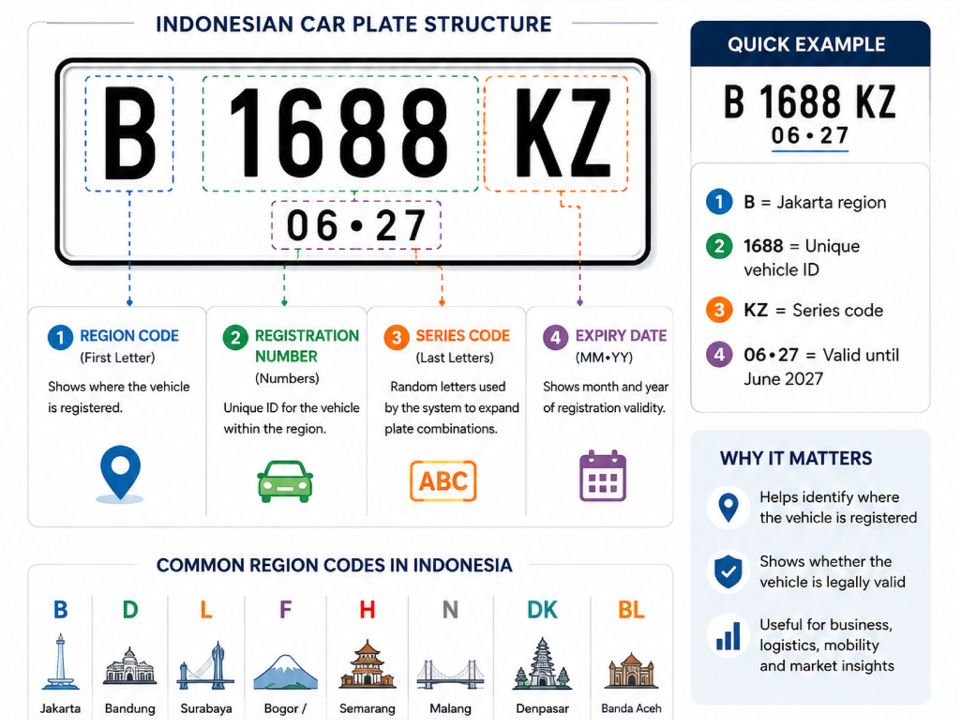
The first character on every Indonesian licence plate represents the region where the vehicle is officially registered.
For example, vehicles carrying the letter B are registered in the Greater Jakarta area, while D represents Bandung in West Java. Other common regional codes include L for Surabaya, F for Bogor and Sukabumi, and H for Semarang.
These prefixes make it easy to identify where a vehicle comes from, offering useful insights for businesses involved in transportation, logistics and regional operations.
Following the regional code is a series of numbers, such as 1688.
Unlike the first letter, these numbers do not indicate the vehicle’s location or type. Instead, they function as a unique registration number assigned to that vehicle within its registration region.
Think of it as a personal identification number that distinguishes one vehicle from another while keeping the registration system organised.
After the numbers, Indonesian licence plates usually include one to three additional letters.
These letters are primarily used to expand the number of available registration combinations, especially in densely populated regions where new vehicles are registered every day.
Although many people assume these letters represent specific districts or vehicle categories, they mainly serve as administrative identifiers generated by the registration system.
One of the most important details appears at the bottom of the licence plate as a month and year format, such as 06•27.
This indicates that the vehicle’s registration and road tax remain valid until June 2027. Authorities use this information to verify whether a vehicle complies with registration requirements and taxation regulations.
For vehicle owners, keeping this date current is essential to ensure the vehicle remains legally registered for use on Indonesian roads.
Consider the registration plate:
B 1688 KZ 06•27
Each section has its own meaning.
The letter B shows the vehicle is registered in Jakarta. The number 1688 is the vehicle’s unique identification number. KZ is the registration series assigned by the system, while 06•27 indicates that the registration remains valid until June 2027.
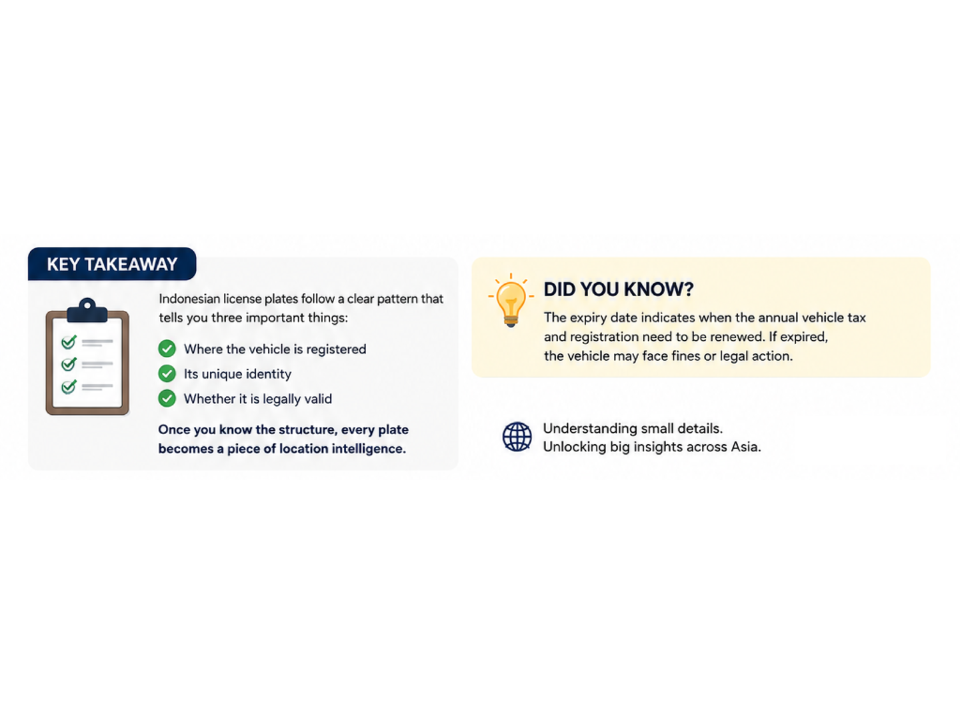
Once you understand this structure, reading Indonesian licence plates becomes straightforward.
Although licence plates are designed primarily for vehicle identification, they also reflect Indonesia’s administrative structure and regional organisation.
For businesses involved in logistics, mobility services, location intelligence or transport planning, registration data can provide valuable insights into vehicle movement, regional distribution and economic activity across different provinces.
As Southeast Asia’s digital economy continues to grow, mobility data is becoming increasingly important in supporting smarter transport systems and better business decision-making.
Indonesia is home to one of Southeast Asia’s largest vehicle populations, making an efficient registration system essential for transportation management and public administration.
For travellers, understanding licence plates adds another layer of local knowledge when exploring the country. For businesses, it offers useful context for logistics, fleet management and regional market analysis, demonstrating how even everyday systems contribute to broader economic and mobility planning.
Asia is full of fascinating systems, innovations and everyday insights that help people better understand how the region works. From transport and infrastructure to business, technology and culture, RiseAsia brings you practical stories that make travelling, investing and doing business across Asia easier.
Discover more regional insights and development stories at RiseAsia.
The first letter identifies the region where the vehicle is registered, such as B for Jakarta and L for Surabaya.
The numbers are a unique registration number assigned to the vehicle and do not indicate its location or vehicle type.
The month and year at the bottom of the plate indicate how long the vehicle’s registration and road tax remain valid.